


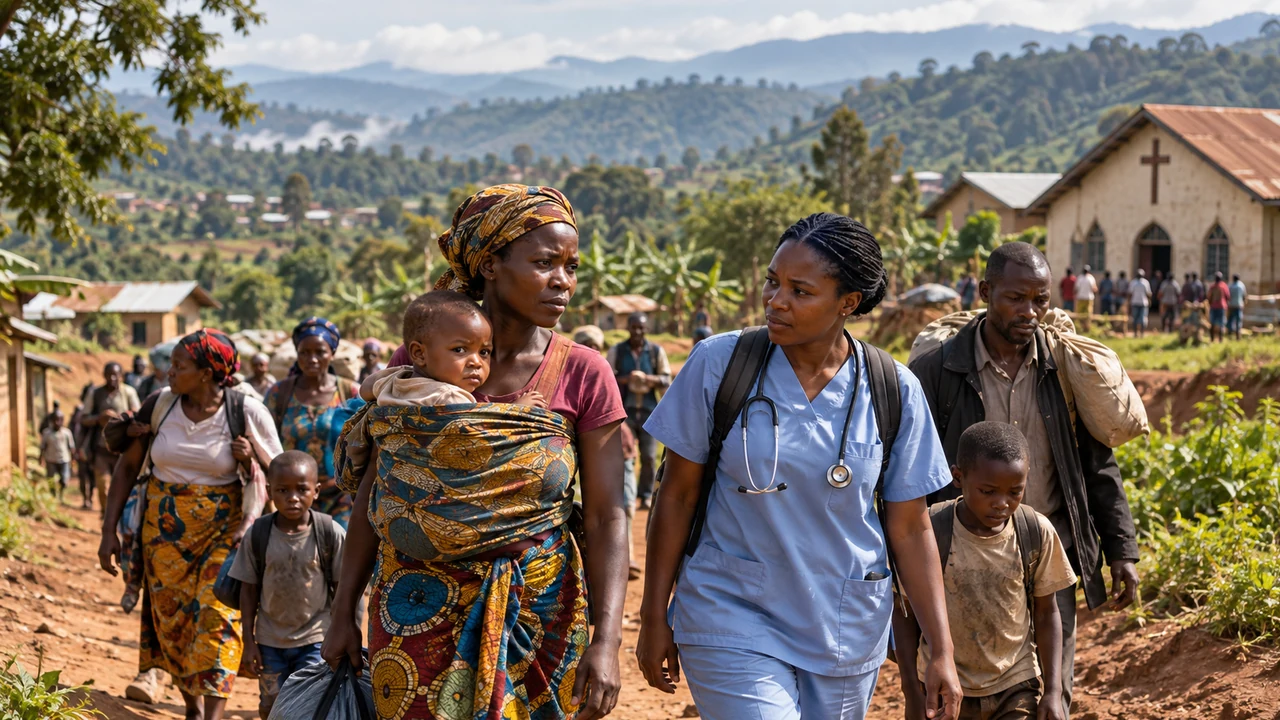
The Democratic Republic of the Congo has one of Africa’s largest populations identifying as Christian, yet many communities—especially in the east—continue to live with war, displacement, hunger, disease, and fear. Believers are worshipping, grieving, caring for neighbours, raising families, and seeking to remain faithful to Christ while armed violence and disease continue to disrupt daily life. Christians elsewhere should pray with compassion for protection, justice, endurance, faithfulness to Christ and the gospel, mercy, and peace.
Prayer Burden at a Glance
Pray especially for civilians, believers, churches, health workers, displaced families, and vulnerable communities in eastern and northeastern Congo. New diplomatic and ceasefire-monitoring mechanisms are in place, but fighting has continued. The Allied Democratic Forces also remain a grave threat to civilians and have an established record of attacking predominantly Christian communities. Hunger remains severe: WFP reports that 26.5 million people face acute food insecurity.
The Ebola outbreak has expanded considerably. As of September 23, WHO reported 7,890 confirmed cases and 3,799 deaths across 63 health zones in seven provinces. Ituri remained the main centre of the outbreak, while transmission varied across affected provinces. Some areas had begun to improve, but national case numbers remained high and the disease was still spreading into new areas.
Pray that the Lord would protect the vulnerable, restrain those who do evil, strengthen His people, sustain those providing care, give wisdom to those pursuing peace, and grant mercy and just and lasting peace.
Last verified: September 30, 2026
Why Democratic Republic of the Congo Needs Prayer Now
Eastern Congo continues to face armed conflict, displacement, hunger, disease, and insecurity even as diplomatic efforts seek a path toward peace.
The Democratic Republic of the Congo needs sustained prayer because war, displacement, hunger, disease, and political disagreement are affecting the country at the same time. Eastern communities continue to face armed conflict, civilian deaths, disrupted livelihoods, and the fear of further fighting. Late-September clashes in Masisi show that the conflict remains active despite continuing diplomatic efforts.
Millions of Congolese also face hunger and displacement. WFP reports that 26.5 million people face acute food insecurity, with conflict-affected eastern provinces among the areas under greatest pressure. Families already weakened by violence and repeated displacement may also struggle to obtain food, health care, education, and stable livelihoods.
The Ebola outbreak has added another severe challenge. By September 23 it had affected 63 health zones across seven provinces. WHO reported both continuing geographic spread and different patterns between provinces: Ituri remained the epicentre, North Kivu had become the second most affected province, and insecurity and displacement continued to make surveillance, contact tracing, infection control, and timely care more difficult.
These crises do not stand apart from one another. Conflict can drive displacement and hunger, while insecurity can also make disease control and humanitarian assistance harder. Christians should pray for the whole country while giving particular attention to communities where suffering is most severe.
Country Snapshot
A brief orientation to the country’s setting, leadership, church context, and the conditions behind its main prayer needs.
The Democratic Republic of the Congo stretches across Central Africa and borders nine countries. Its size and location help explain why armed conflict, population movement, disease, trade, and diplomacy in the east can affect neighbouring countries as well as Congo itself.

Christian identity is widespread and public, but that does not mean that everyone who identifies as Christian has saving faith in Christ. Churches and communities that call themselves Christian differ widely in doctrine, practice, and spiritual health. Christians should pray that the gospel would be clearly proclaimed, that professing believers would be grounded in Scripture, and that those who truly trust Christ would grow in holiness, courage, love, and faithful witness.
The country’s most severe present crises are not spread evenly. North Kivu, South Kivu, and Ituri continue to face especially serious conflict and displacement, while Ebola now affects a wider group of provinces. This gives Christians reason to pray for the whole country while remembering the places under greatest pressure.
Spiritual and Practical Challenges Affecting Christians and Churches
In eastern Congo especially, churches serve amid armed violence, displacement, hunger, grief, disease, insecurity, and the continuing threat of attacks on Christian communities.
Armed violence and repeated displacement
Churches in parts of North Kivu, South Kivu, and Ituri serve communities where violence can disrupt travel, livelihoods, schooling, medical care, and ordinary congregational life. Late-September fighting in Masisi shows that communities still face the danger of further violence. Congregations may be caring for displaced households, bereaved families, frightened children, and people who have lost homes or livelihoods while church members and leaders face many of the same dangers.
Allied Democratic Forces violence
The Allied Democratic Forces remain a serious threat to Christian communities in affected areas. USCIRF has documented attacks on houses of worship, religious leaders, and predominantly Christian communities. Not every ADF attack should automatically be described as religiously motivated, but this documented pattern gives churches in affected areas particular reason to pray for protection when they gather, serve, and witness publicly.
Hunger, grief, and prolonged exhaustion
Conflict and displacement have left many churches serving people whose needs go far beyond immediate physical safety. WFP reports that 26.5 million people face acute food insecurity. Pastors and congregations may be comforting bereaved families, helping hungry and displaced people, continuing worship and discipleship, and offering practical care while living with limited resources themselves.
Disease amid insecurity
The Ebola outbreak makes daily life and care even harder in communities already affected by conflict and displacement. WHO says insecurity and limited access to basic services continue to make outbreak control more difficult. Churches and Christian families need wisdom to care compassionately for people affected by illness and bereavement while also encouraging accurate information, appropriate treatment, and responsible public-health practices.
Christian Life and Witness in Democratic Republic of the Congo
Christian life is highly visible across much of the country, yet genuine faithfulness requires clear gospel preaching, biblical discipleship, perseverance, and mercy amid suffering.
Christian language and church life are highly visible across much of the Democratic Republic of the Congo. Churches gather publicly, Christian institutions play important social roles, and many people identify themselves as Christian. Yet inherited religion, public Christian identity, church membership, or participation in Christian institutions should never be treated as proof of regeneration or saving faith.
Pray that churches would proclaim clearly that sinners are reconciled to God by grace through faith in Jesus Christ. Pray for pastors and teachers who are faithful to Scripture, for genuine repentance and faith, and for professing Christian communities to be continually brought under the authority of God’s Word.
For believers in conflict-affected parts of the east, ordinary Christian faithfulness can require great perseverance. Christians continue to worship, pray, bury the dead, care for displaced families, comfort the grieving, and serve their neighbours amid insecurity. Some communities also live with the knowledge that Christian gatherings, leaders, and villages have previously been directly targeted by the ADF.
Faithfulness in such conditions requires grace not only to endure suffering but also to resist hatred, revenge, despair, corruption, manipulation, superstition, and false teaching. Pray that believers would hold fast to Christ, love their neighbours, test teaching by Scripture, and speak the gospel with courage and compassion.
Their deepest hope does not rest in political agreements, military victories, or improved circumstances alone. Pray that believers would remain faithful as they seek God’s kingdom, bear witness to Christ, and wait for the day when He will make all things new.
Recent Developments
Recent conflict, peace efforts, Ebola developments, and national political debate all affect how Christians can pray for the Democratic Republic of the Congo now.
-
January–February 2025
M23 territorial gains deepened the eastern crisis
The capture of Goma and Bukavu by M23 during early 2025 marked a major escalation in the eastern conflict and increased civilian vulnerability, displacement, and humanitarian need. Those territorial changes continue to shape the conflict addressed by current peace efforts.
Prayer significance: Pray for civilians still living with the effects of territorial conflict, for restraint among armed actors, and for peace that protects people and upholds justice.
-
February 2026
A deadly attack struck a Christian community in North Kivu
USCIRF documented the killing of around 70 civilians in a Christian village in North Kivu as part of the ADF’s wider pattern of attacks affecting religious communities.
Prayer significance: Pray for grieving families, vulnerable congregations, pastors, and communities that continue to live under threat.
-
April–September 2026
Peace mechanisms advanced while fighting continued
Diplomatic efforts and ceasefire-monitoring arrangements connected with the Doha and Washington processes advanced during 2026. Ceasefire-verification missions took place in Minembwe and Masisi, while the Joint Security Coordination Mechanism established under the Washington process met again in Geneva on September 16–17. Yet fighting continued in eastern Congo.
These steps may help restrain violence and support negotiation, but they have not yet produced reliable peace for civilians.
Prayer significance: Give thanks for every genuine opening toward verification, restraint, and negotiation. Pray that diplomatic commitments would lead to protection for civilians, humanitarian access, accountability, and durable peace.
-
May–September 2026
Ebola expanded to seven provinces
By September 23, WHO had recorded 7,890 confirmed Ebola cases and 3,799 deaths across 63 health zones in seven provinces. Ituri remained the epicentre, North Kivu was the second most affected province, and the outbreak had spread into additional areas of Haut-Uélé and Sud-Ubangi.
The pattern was not the same everywhere. Ituri had been declining gradually from its mid-August peak, while North Kivu declined in the latest reporting days after reaching its highest incidence in mid-September. Haut-Uélé continued sustained transmission, while Tshopo showed renewed activity. Despite these differences, national case numbers remained high and the outbreak continued to place heavy demands on health workers and affected communities.
Prayer significance: Pray for the sick and bereaved, protection and endurance for health workers, early diagnosis and treatment, accurate communication, community cooperation, and continued decline in transmission wherever progress has begun.
-
August–September 2026
National dialogue and constitutional disagreement became prominent public issues
President Félix Tshisekedi announced a National Dialogue for peace, cohesion, and the refoundation of the state in late August, and the presidency continued discussing its implementation in September. The government presents the initiative as a way to address instability, reconciliation, democratic consolidation, and national cohesion.
At the same time, opposition groups organized demonstrations against possible constitutional changes, arguing that such changes could open a path toward another presidential term. The September 15 demonstrations were treated differently across the country: an agreed route was established in Kinshasa, while gatherings elsewhere were in some cases prohibited, blocked, or dispersed.
Prayer significance: Pray for truthful leadership, peaceful political participation, respect for legitimate civic freedoms, restraint by both authorities and demonstrators, and national dialogue that genuinely seeks justice, peace, and the good of the Congolese people.
How to Pray
Pray for protection, endurance, mercy, peace, truthful leadership, gospel faithfulness, and Christian hope.
-
Pray for civilians living under the threat of armed conflict. Ask the Lord to restrain those who kill, abduct, exploit, or terrorize others; protect families in conflict-affected areas; and grant peace that is just and durable rather than merely a temporary pause in violence.
-
Pray for believers and churches threatened by ADF violence. Ask God to protect congregations, pastors, and Christian communities; comfort those who have lost loved ones; and keep His people steadfast in Christ rather than overcome by fear, hatred, or revenge.
-
Pray for displaced and hungry families. Ask God to provide food, shelter, safety, health care, and stable livelihoods. Pray that churches and humanitarian workers would have the strength and resources to serve people whose homes and communities have repeatedly been disrupted.
-
Pray for those affected by Ebola and for everyone working to contain the outbreak. Ask God to protect health workers, help sick people receive early treatment, give communities reliable information, strengthen trust between families and response teams, and continue to reduce transmission where improvement has begun.
-
Pray that peace efforts would protect ordinary people. Ask God to give negotiators, mediators, military leaders, and public officials wisdom, honesty, humility, and restraint. Pray that ceasefire monitoring and diplomatic agreements would reduce violence in practice.
-
Pray for truthful and just national leadership. Ask God to give those in authority, opposition leaders, lawmakers, judges, provincial officials, and security services wisdom and a genuine concern for the good of the people. Pray that national dialogue and constitutional disagreements would be handled peacefully and truthfully, without violence or intimidation.
-
Pray for the church to remain faithful to Christ. Ask the Lord to raise up faithful pastors, elders, evangelists, and ordinary believers; deepen biblical teaching and discipleship; expose false teaching and empty religious profession; bring sinners to repentance and faith in Christ; and help believers serve suffering neighbours without compromising the truth of the gospel.
-
Pray for believers to endure with Christian hope. Ask God to keep His people from despair when political agreements and other human efforts do not quickly bring peace or security. Pray that they would live in holiness, courage, compassion, and hope as they seek His kingdom and wait for Christ.
Give Thanks
Give thanks for genuine gospel faithfulness, compassionate service, and every real opening toward healing, protection, and peace.
-
Give thanks for genuine Christian faithfulness amid suffering. Thank God for believers who continue to worship, care for displaced families, comfort the grieving, serve their neighbours, and speak of Christ under difficult conditions.
-
Give thanks for those serving the sick and helping communities respond to Ebola. Thank God for every recovered patient, every health worker who continues to serve, and signs that transmission has declined in some affected areas. Continue to pray for places where the outbreak remains severe.
-
Give thanks for every genuine opening toward ceasefire verification, humanitarian access, dialogue, and peaceful settlement. Pray that these efforts would lead to real protection for civilians rather than remaining only diplomatic commitments.
-
Give thanks for every place where Christ is faithfully proclaimed and Scripture is taught. Thank God for genuine gospel fruit, courageous witness, mercy toward those in need, and believers being strengthened in faith. Pray that all professing Christian communities would be continually reformed by God’s Word and brought into greater faithfulness to the gospel.
Last Verified / Update Note
This note helps readers understand when the guide was reviewed and which developments may affect how they use it for prayer.
Review Status
Reviewed for current prayer use
This guide was reviewed against current information on armed conflict and civilian protection in eastern Congo, ADF violence, displacement and hunger, the Bundibugyo Ebola outbreak, the Doha and Washington peace processes, national dialogue and constitutional disagreement, religious-freedom concerns, and the pressures facing churches and Christian communities.
The principal concerns remain active fighting and civilian insecurity in the east; displacement and severe food insecurity; ADF violence and the particular vulnerability of Christian communities; the continuing Ebola outbreak; the need for peace agreements to produce real protection for civilians; truthful and peaceful national leadership; and faithful gospel witness by churches and believers.
Important developments include any material ceasefire or territorial change in the east; further WHO updates on Ebola transmission and geographic spread; implementation of the Doha and Washington peace arrangements, including ceasefire verification and the planned next stages of security coordination; changes affecting ADF activity and civilian protection; and any formal decisions arising from the National Dialogue or constitutional debate.
Sources include official Congolese material, UN and humanitarian agencies, peace-process statements, national reporting, religious-freedom research, and other reputable analysis. Claims from the DRC, Rwanda, opposition figures, armed actors, or other interested parties are clearly attributed and are not presented automatically as independently established fact. Fast-changing figures are dated to the source used.
Help keep this guide accurate and current
If you noticed a possible correction, broken link, or significant country update, please contact the Nations Prayer Directory so we can review it carefully.
Key Sources Consulted
Sources that materially informed this Democratic Republic of the Congo prayer guide, including public-health, humanitarian, conflict, religious-freedom, peace-process, national, and political sources.
Public health and humanitarian conditions
- World Health Organization — Ebola Disease Outbreak News, September 25, 2026. WHO’s September 25 report gives data through September 23: 7,890 confirmed cases, 3,799 deaths, and 63 affected health zones across seven provinces.
- World Food Programme — Democratic Republic of the Congo. WFP reports that 26.5 million people face acute food insecurity and provides broader humanitarian context for the country.
- UNHCR — Democratic Republic of the Congo. UNHCR provides national displacement information; its published figures differ from some other humanitarian sources, reflecting differences in datasets or reporting periods.
Conflict, civilian protection, and religious freedom
- MONUSCO — Beni civilian-protection update, September 24, 2026. MONUSCO reports continuing ADF attacks, insecurity, and resulting displacement in North Kivu.
- Radio Okapi — Masisi fighting, September 29, 2026. Radio Okapi reports serious late-September fighting in Masisi and resulting civilian harm.
- U.S. Commission on International Religious Freedom — Nonstate Violators of Religious Freedom in the DRC. USCIRF documents a pattern of ADF attacks affecting houses of worship, religious leaders, and predominantly Christian communities.
Peace processes and regional diplomacy
- Security Council Report — DRC Briefing and Consultations, September 28, 2026. Security Council Report summarizes the August–September Doha developments, ceasefire-verification missions, the September 16–17 JSCM meeting, continuing DRC–Rwanda disagreements, and the continuing gap between diplomatic agreements and reliable peace on the ground.
- Qatar Ministry of Foreign Affairs — Expanded Joint Verification Mechanism field mission. Qatar’s Ministry of Foreign Affairs reports practical ceasefire-verification activity under the Doha process.
- Radio Okapi — UN Security Council briefing, September 29, 2026. Radio Okapi reports James Swan’s late-September assessment that diplomatic progress had continued while major security and humanitarian problems remained.
National political context
- Presidency of the Democratic Republic of the Congo — September 15, 2026. The Congolese presidency describes the National Dialogue in terms of national reconciliation, democratic consolidation, social priorities, and the Ebola response.
- Radio Okapi — September 15 opposition demonstrations. Radio Okapi reports opposition mobilisation against possible constitutional change and differing treatment of demonstrations across Congolese cities.
Source Context
How to read fast-changing health, conflict, displacement, diplomatic, religious-freedom, and political information used in this guide.
Source Context
- Source mix. This guide combines direct government and mediation sources with Congolese national reporting, UN and humanitarian agencies, religious-freedom research, and independent international analysis. No single source gives a complete account of the country’s political or security situation.
- Ebola figures. WHO’s September 25 Disease Outbreak News reports data through September 23. Later briefings may contain newer provisional totals because different institutions update their figures on different schedules. For that reason, the Ebola figures are dated rather than presented as permanent totals.
- Conflict and peace-process claims. Peace mechanisms under the Doha and Washington processes have advanced, including field verification and the September 16–17 Joint Security Coordination Mechanism meeting, but late-September fighting shows that these developments have not yet produced peace on the ground.
- DRC and Rwanda positions. Both governments continue to dispute responsibility for failures in implementing security commitments. Those government statements are not treated as independently verified facts. At the September 29 Security Council meeting, the Congolese representative presented the DRC’s allegations concerning areas under AFC/M23 control, while Rwanda’s representative emphasized implementation and verification of the agreements and Rwanda’s stated security concerns.
- National politics. The Congolese presidency presents the National Dialogue as a process for reconciliation, peace, cohesion, and democratic consolidation. Opposition groups have campaigned against possible constitutional changes that they say could permit another presidential term. These remain distinct political positions. The outcome of any constitutional process remains uncertain, and the available sources do not establish the motives of every political actor.
- Displacement figures. Current public humanitarian sources display different national displacement totals—for example, WFP lists 7.8 million internally displaced people while UNHCR’s country page lists 6.9 million. Because these figures may use different datasets or reference periods, the sources do not support treating either number as a single uncontested national total. Millions remain internally displaced.
- Religious-freedom evidence. USCIRF documents a pattern of ADF attacks affecting Christian communities, houses of worship, and religious leaders. That broader pattern does not establish a religious motive for every individual ADF attack.
A Closing Prayer for Democratic Republic of the Congo
A concise prayer gathering the Democratic Republic of the Congo’s present burdens before the Lord.


