


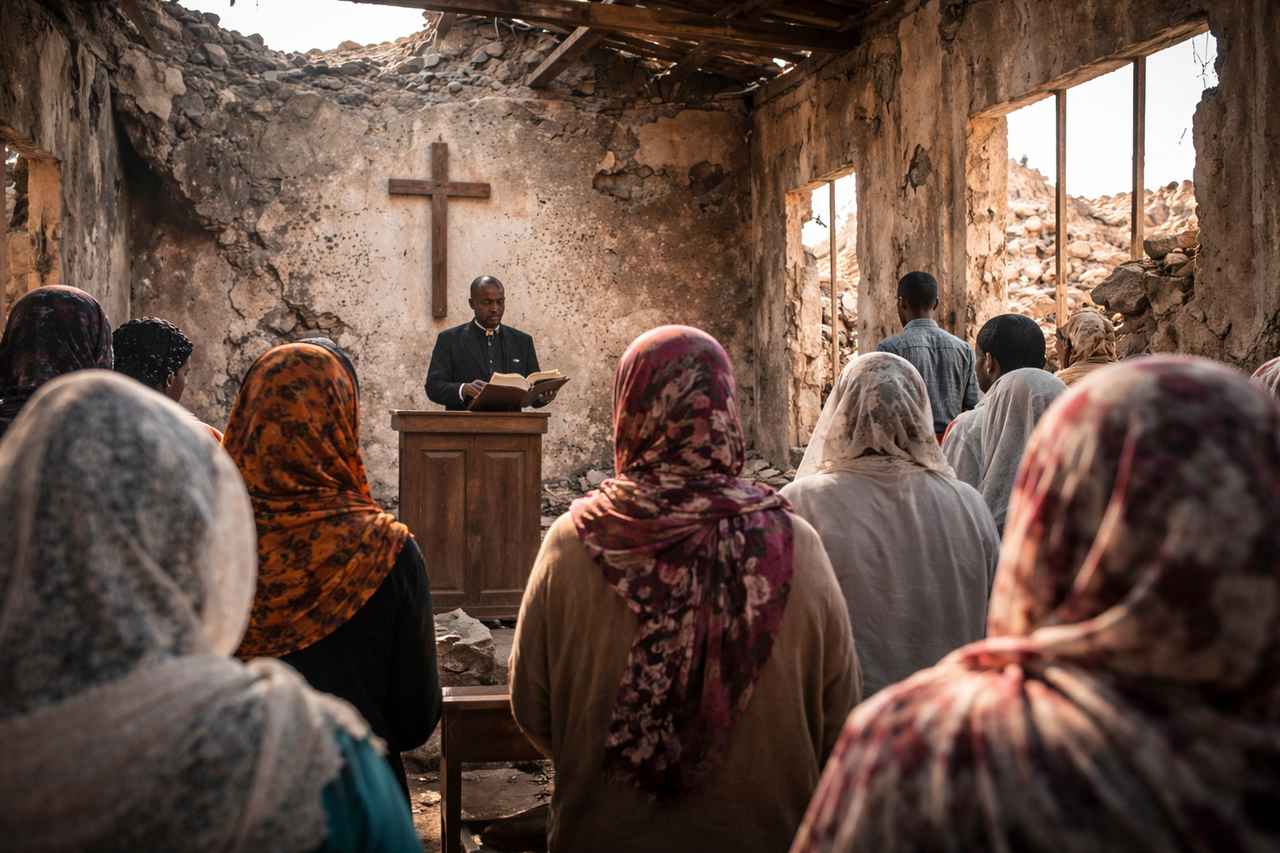
Sudan’s war has entered its fourth year and continues to shape daily life across the country. Millions of people remain displaced, severe hunger persists, health services are being lost or reduced, and violence continues to uproot families. Christians share in this national suffering while also facing the vulnerabilities of being a small religious minority, including restrictions on worship, damaged or occupied churches, danger to church leaders, and particular risks for converts. Sudan needs prayer for peace, protection, daily provision, faithful churches, and mercy for people whose lives have been repeatedly disrupted by war.
Prayer Burden at a Glance
Pray that God would restrain violence, protect civilians, provide food and medical care, keep humanitarian help moving, and sustain displaced families. Pray also for Sudanese Christians to remain faithful in worship, witness, mercy, and love amid fear, loss, and uncertainty.
Last verified: September 2026
Why Sudan Needs Prayer Now
War, mass displacement, severe hunger, damaged services, and continuing pressure on churches all shape Sudan’s present need for prayer.
Sudan’s suffering remains severe. The war that began in April 2023 between the Sudanese Armed Forces and the Rapid Support Forces has destroyed homes, markets, hospitals, schools, farms, roads, livelihoods, and places of worship. As of August 24, 2026, UNHCR reported more than 11.29 million forcibly displaced people connected to the Sudan crisis. Millions remain displaced inside Sudan, while millions more have crossed into neighboring countries.
Hunger is another grave danger. The May 2026 Integrated Food Security Phase Classification analysis found that nearly 19.5 million people – about 41 percent of the population – faced Crisis-level or worse acute food insecurity between February and May. It did not classify any area as being in Famine at that time, but identified 14 areas in North Darfur, South Darfur, and South Kordofan as being at risk of Famine under a reasonable worst-case scenario if conditions deteriorated further. Later projections covered only part of Sudan because sufficient data for a nationwide projection was unavailable.
The humanitarian crisis is made worse by damaged services and difficult access. The Sudan Health Cluster warned in June that hundreds of health facilities and services were at risk because of funding losses. By September 9, aid organizations reported that dozens of clinics were closing, affecting hundreds of thousands of people. Children remain especially vulnerable to hunger, disease, displacement, disrupted education, and violence.
There are also places where humanitarian access has been kept open. Sudan’s government extended the opening of the Adré crossing with Chad for international humanitarian relief through September 30, 2026. Yet fighting, insecurity, damaged infrastructure, and communications problems continue to interrupt humanitarian work. Sudan therefore needs prayer not only for sufficient aid, but also for safe and dependable access so that food, medicine, clean water, shelter, and other help can reach people in need.
For Christians, the national crisis is inseparable from church life. Believers endure the same displacement, hunger, bereavement, disease, insecurity, and economic loss as their neighbors. At the same time, churches and converts may face additional discrimination, restrictions, damaged places of worship, or danger to Christian leaders. Prayer for Sudan should therefore hold together the suffering of the whole country and the particular need of Christ’s people for courage, protection, faithfulness, and grace to serve their neighbors.
Country Snapshot
A brief orientation to Sudan’s location, population, religious setting, and war-affected national context.
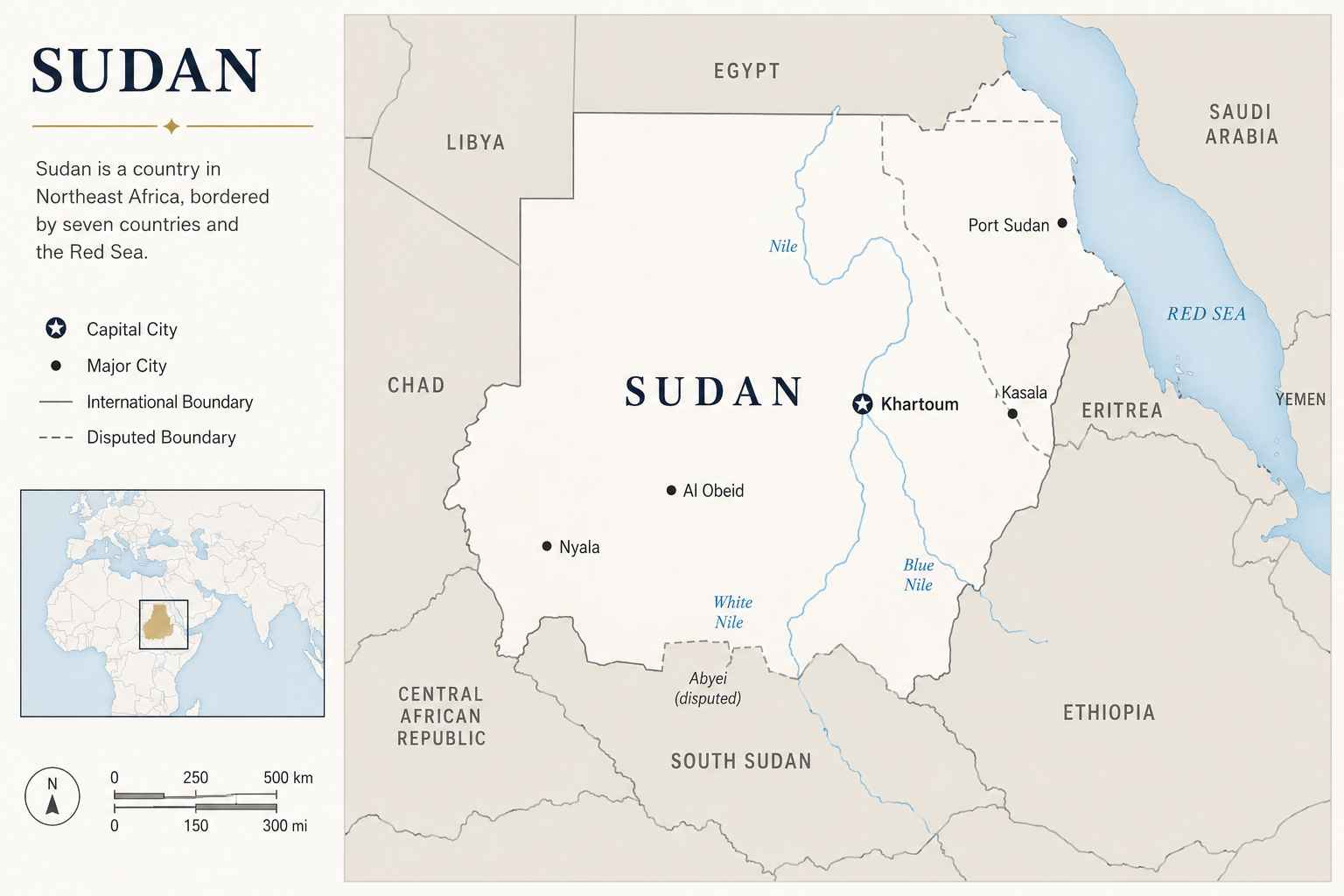
Sudan is a large country in northeastern Africa, bordering the Red Sea and neighboring Egypt, Libya, Chad, the Central African Republic, South Sudan, Ethiopia, and Eritrea. The World Bank lists Sudan’s 2024 population at about 50 million.
Sudan’s population is overwhelmingly Muslim. Christians form a small minority that includes historic Christian communities, Protestant and evangelical believers, converts from Islam, and expatriate Christians. Open Doors lists Sudan at number 4 on its 2026 World Watch List.
Sudan remains deeply divided by war. The Sudanese Armed Forces, often called the army, and the Rapid Support Forces, a powerful paramilitary force, remain the principal belligerents, while other armed movements and local conflicts add to the insecurity in some areas. Because control of territory can change quickly, this guide does not attempt to track every battlefield shift. Its prayer focus remains on realities that are clearer and more enduring: violence, displacement, hunger, damaged services, church vulnerability, and the need for a just and lasting peace.
Spiritual and Practical Challenges Affecting Christians and Churches
Sudanese Christians share the country’s suffering while also facing pressures that can make worship, discipleship, leadership, and ordinary church life more difficult.
War, displacement, and weakened church life
Christians in Sudan suffer the consequences of war alongside their neighbors: displacement, bereavement, hunger, trauma, lost livelihoods, closed schools, damaged health services, and insecurity. These pressures also disrupt ordinary church life. Congregations may be scattered, pastors separated from members, families deprived of homes and income, and churches trying to care for vulnerable people with very limited resources.
Religious-freedom restrictions and discrimination
The U.S. Commission on International Religious Freedom has reported renewed concerns about religious freedom during the war, including attacks on places of worship, arbitrary detention of members of religious minorities, obstacles affecting humanitarian relief, and fear among minority communities. These concerns exist within a wider breakdown of law and public order that can leave minorities especially exposed.
Church buildings and converts under strain
Open Doors reports that church buildings have been bombed, taken over, damaged, or used by armed groups, while Christians may face discrimination in courts, workplaces, schools, and other areas of public life. Converts from Islam can face particular danger because following Christ may bring family rejection, community hostility, threats, or violence in addition to the insecurity experienced by the wider population.
Church leaders exposed to violence
Christian leaders may also be caught in Sudan’s wider armed, ethnic, and local conflicts. Christian Solidarity Worldwide reported that a Catholic priest and two church guards were killed at a church in Kauda, South Kordofan, in June during local armed violence involving communities that were themselves predominantly Christian. Open Doors later reported the death of an Episcopal pastor after he was shot in South Kordofan and described other killings and kidnappings affecting Christians.
These incidents should not all be described as religious persecution. They do, however, show how seriously violence and insecurity can endanger church leaders and congregations.
Christian Life and Witness in Sudan
Faithful Christian life continues under extraordinary strain as believers worship, serve, disciple, and care for neighbors amid displacement and insecurity.
For many Sudanese Christians, faithfulness now means trying to live an ordinary Christian life under extraordinary strain. Worship may continue among scattered members, with damaged or inaccessible buildings, dangerous travel, lost livelihoods, and the weight of bereavement. Some believers have fled their homes. Others remain while caring for relatives, serving congregations, or simply because they have nowhere safer to go.
Church leaders carry a demanding responsibility. Pastors, priests, elders, evangelists, and other leaders may be shepherding people who are displaced, traumatized, hungry, afraid, or grieving while facing many of the same dangers themselves. Recent deaths of church leaders add urgency to prayer for those who continue serving in insecure areas.
Converts from Islam may face another layer of difficulty. Following Christ can bring rejection or hostility within families and communities, while war may separate believers from congregations, pastors, Christian relatives, and other sources of fellowship and support.
Yet Christian worship and service have not disappeared. Believers continue praying, gathering where possible, teaching Scripture, caring for one another, and serving neighbors. The church’s calling in Sudan includes endurance, but also mercy: feeding the hungry where possible, comforting those who mourn, serving people across ethnic and religious divisions, and refusing to let fear, hatred, or revenge determine how Christians treat their neighbors.
Recent Developments
Severe hunger, mass displacement, fragile humanitarian access, health-service losses, and renewed violence in South Kordofan are especially important for prayer in September 2026.
-
May 2026
Severe hunger and risk of Famine remain central
The May IPC analysis found nearly 19.5 million people facing high levels of acute food insecurity. It identified 14 areas in North Darfur, South Darfur, and South Kordofan as being at risk of Famine under a reasonable worst-case scenario. The June-September projection did not cover the whole country because sufficient data was unavailable, so this guide does not treat that partial projection as a nationwide estimate.
Prayer significance: Pray for food to reach vulnerable communities, for children and families threatened by hunger, and for conditions that could push more areas toward catastrophe to be restrained.
-
January-April 2026
Drone warfare increased danger to civilians
Associated Press reporting in May 2026 described drones as an increasingly deadly feature of Sudan’s war during the first months of 2026, including attacks affecting civilian communities and infrastructure. This matters because civilians may face danger even far from conventional front lines.
Prayer significance: Pray for civilians exposed to attacks, for restraint by those using military force, and for the protection of homes, hospitals, schools, markets, and displacement sites.
-
June-August 2026
Displacement remains immense
UNHCR reported more than 11.29 million forcibly displaced people connected to the Sudan crisis as of August 24. Because different displacement categories use different reporting dates, this figure is dated rather than presented as a fixed total.
Prayer significance: Pray for displaced people inside Sudan and for those who have crossed borders, asking God to provide safety, shelter, family stability, and trustworthy help.
-
June-September 2026
Humanitarian access remains uneven
The Sudanese government extended the Adré crossing with Chad for humanitarian relief through September 30. The United Nations welcomed the decision, while also reporting interruptions caused by insecurity and communications problems. Permission for aid to move across a border can help, but it does not by itself guarantee that assistance will safely reach communities in need.
Prayer significance: Pray for safe and dependable humanitarian access, for protection of aid workers, and for food, medicine, water, and shelter to reach communities cut off by war.
-
June-September 2026
Health services face further losses
The Sudan Health Cluster warned in June that 335 health facilities and services across 13 states were at immediate risk because of funding disruption. On September 9, aid organizations reported that 36 clinics were closing, affecting access to care for more than 473,000 people. These losses come while conflict-affected communities are also facing disease outbreaks and severe damage to the wider health system.
Prayer significance: Pray for threatened clinics to keep serving where possible, for medical workers to be protected and supplied, and for sick and malnourished people to receive care.
-
June-September 2026
South Kordofan remains especially dangerous
South Kordofan has continued to experience armed and local violence. Christian Solidarity Worldwide reported the June killing of a Catholic priest and two church guards in Kauda, while Open Doors reported further deaths and kidnappings affecting Christians in July and August. In early September, reporting from Kauda described renewed clashes that killed civilians and displaced hundreds.
These incidents have different immediate causes and should not all be described as religious persecution. Together, however, they show how war, local conflict, displacement, and insecurity continue to endanger civilians, church leaders, and Christian communities.
Prayer significance: Pray for civilians and churches in South Kordofan, for protection of Christian leaders, and for restraint and reconciliation amid overlapping armed and communal conflicts.
How to Pray
Pray for peace and protection across Sudan, while asking the Lord to sustain His church in faithful worship, mercy, discipleship, and gospel witness.
Pray for an end to the violence and for a just peace. Ask God to restrain cruelty, protect civilians, humble those who pursue power through violence, expose injustice and falsehood, and move military and political leaders toward a peace that protects ordinary people.
Pray for displaced, hungry, and vulnerable families. Ask the Lord to provide shelter, food, clean water, safety, and trustworthy help for people who have lost homes, livelihoods, schools, churches, and familiar communities.
Pray for health care and humanitarian access. Pray for the sick, injured, malnourished, elderly, pregnant women, children, and people with disabilities. Ask God to protect medical and humanitarian workers, preserve threatened health services, and keep safe routes open for aid.
Pray for Christians to endure faithfully. Ask God to strengthen believers under grief, fear, displacement, uncertainty, and exhaustion, guarding them from despair, bitterness, compromise, revenge, and unbelief.
Pray for church leaders. Pray for pastors, priests, elders, evangelists, and other leaders shepherding scattered and traumatized believers. Ask the Lord to protect them and give them courage, wisdom, sound doctrine, compassion, and endurance.
Pray for converts and other vulnerable believers. Pray especially for Christians from Muslim backgrounds and others who may face family rejection, social hostility, discrimination, threats, or violence because they follow Christ.
Pray for worship, discipleship, and Christian mercy. Ask God to preserve congregational fellowship, the teaching of Scripture, discipleship, care for the weak, and service to neighbors across ethnic, tribal, political, and religious divisions.
Pray for gospel fruit. Pray that many Sudanese would repent and believe in Christ, and that the Lord would preserve a humble, courageous, truthful church whose words and actions point people to Him.
Give Thanks
Give thanks for God’s preserving mercy, faithful believers, and acts of service that continue even while Sudan’s suffering remains severe.
Give thanks that Christ continues to preserve His church in Sudan through war, displacement, hunger, and fear.
Give thanks for believers and church leaders who continue to worship, teach Scripture, pray, care for the grieving, and serve others under severe strain.
Give thanks for medical workers, humanitarian responders, churches, neighbors, and local helpers who continue acts of mercy despite danger and limited resources.
Give thanks for every route that remains open for food, medicine, shelter, and protection to reach people in need.
Give thanks that God remains sovereign and merciful even where suffering is prolonged, and that His people can still hope in Him when earthly circumstances offer little encouragement.
Last Verified / Update Note
This note helps readers understand when the guide was reviewed and which fast-changing developments may affect how they use it for prayer.
Review Status
Reviewed for current prayer use
The continuing war; displacement; acute food insecurity and risk-of-Famine language; humanitarian access; losses in health services; recent violence in South Kordofan; and developments affecting Christian communities and church leaders.
Protection of civilians; an end to armed violence and a just peace; food, medicine, and safe humanitarian access; care for displaced families; protection and strengthening of churches and Christian leaders; support for vulnerable converts; and faithful Christian witness across divided communities.
Further fighting and displacement in Darfur, Kordofan, Blue Nile, and other affected areas; new IPC food-security or Famine classifications; updated displacement figures; humanitarian access after the present Adré authorization expires on September 30; further health-service closures; and significant new restrictions, attacks, or other developments affecting churches and Christian communities.
Conditions in Sudan can change quickly, and organizations sometimes use different reporting dates or population categories. Fast-changing figures are therefore dated. The guide distinguishes Famine from risk of Famine, does not present partial food-security projections as nationwide estimates, avoids assigning disputed responsibility for attacks without sufficient evidence, and does not present changing battlefield control as settled fact.
Help keep this guide accurate and current
If you noticed a possible correction, broken link, or significant country update, please contact the Nations Prayer Directory so we can review it carefully.
Key Sources Consulted
Sources that materially informed this September 2026 review, including humanitarian data, current conflict reporting, Christian and religious-freedom sources, and Sudanese official statements.
Humanitarian conditions, displacement, and food security
- UNHCR. Sudan Situation Operational Data Portal. Used for current forced-displacement, refugee, returnee, and internal-displacement figures.
- Integrated Food Security Phase Classification. Sudan Acute Food Insecurity Analysis, May 2026. Used for acute food insecurity, Catastrophe classifications, projection coverage, and areas facing risk of Famine.
- World Food Programme. Sudan Emergency. Used for current hunger, nutrition, humanitarian-access, and response context.
- WHO-led Sudan Health Cluster. Urgent funding needed to keep life-saving health services running beyond June. Used for health-service funding pressures and facilities threatened with closure or reduced operation.
- Doctors Without Borders / Médecins Sans Frontières. Aid cuts leave millions without health care across Sudan. Used for September reporting on health facilities closing as humanitarian funding falls.
- UNICEF Sudan. Humanitarian Situation Report, July 2026. Used for child casualties, education, malnutrition, health, and humanitarian conditions.
Humanitarian access and current conflict developments
- United Nations. Secretary-General spokesperson briefing on humanitarian access. Used for humanitarian access, including the Adré crossing and continuing operational interruptions caused by insecurity.
- Sudan Tribune. Report on the extension of the Adré crossing. Used for Sudanese and regional reporting on the government’s extension of the crossing through September 30.
- Associated Press. Report on Sudan clinic closures. Used for September reporting on health-service closures.
- Associated Press. Report on South Kordofan clashes. Used for recent violence and displacement around Kauda and South Kordofan.
- Associated Press. Drones are making Sudan’s war even deadlier for civilians. Used for the January-April 2026 drone-warfare context and civilian risk.
- Darfur24. Renewed violence leaves dead in Heiban, Kauda. Used for closer-to-country September reporting on continuing violence around Heiban and Kauda.
Christian life and religious freedom
- Open Doors. Sudan / World Watch List 2026. Used for Christian vulnerability, pressures on church life and converts, and Sudan’s 2026 World Watch List position.
- Open Doors UK & Ireland. Reporting on recent attacks affecting Sudanese Christians. Used for August 2026 reporting on Christians and church leaders killed or kidnapped amid continuing violence.
- U.S. Commission on International Religious Freedom. Sudan Issue Update. Used for religious-freedom concerns arising during the war, including threats to religious minorities and places of worship.
- Christian Solidarity Worldwide. Report on the Kauda church attack. Used for the June 2026 killing of a Catholic priest and church guards in Kauda and the intercommunal context surrounding the attack.
Official Sudanese perspective
- Republic of Sudan / Office of the Prime Minister. Official statement concerning Christians and churches. Used to represent the government’s stated position on religious freedom, houses of worship, and Christian communities; not as independent verification of disputed claims.
- Republic of Sudan / Office of the Prime Minister. Official statement on human-rights cooperation. Used to represent the government’s stated human-rights position; not as independent verification of disputed claims.
Background
- World Bank. Sudan country data. Used for population background.
Source Context
How to read the sources behind this guide in a fast-changing war, humanitarian emergency, and contested reporting environment.
Source Context
- Fast-changing figures. Displacement, casualty, health-service, and humanitarian-access figures can change quickly. This guide dates those figures rather than presenting them as permanent totals.
- Food-security language. The May 2026 IPC analysis covered Sudan nationwide for February-May, but its June-September projection covered a much smaller set of localities because sufficient data was unavailable elsewhere. The guide therefore does not turn the partial projection into a nationwide estimate and does not use Famine where the current IPC analysis supports only risk of Famine.
- Conflict and attack attribution. Reporting from South Kordofan reflects armed, factional, ethnic, and communal conflicts whose immediate causes and responsibility may differ from incident to incident. Violence affecting Christians is therefore not automatically described as religious persecution, and disputed responsibility is not presented as settled fact.
- Source mix and official position. The guide uses Sudanese government statements, national and closer-to-country reporting, United Nations and humanitarian sources, reputable international reporting, and Christian and religious-freedom organizations. Government statements are used to show the government’s stated position, while independent sources are used to assess conditions. Where the parties to the conflict make competing claims, the guide avoids deciding between them unless the claim is necessary and adequately established.
A Closing Prayer for Sudan
A concise prayer gathering Sudan’s present burden before the Lord.


